
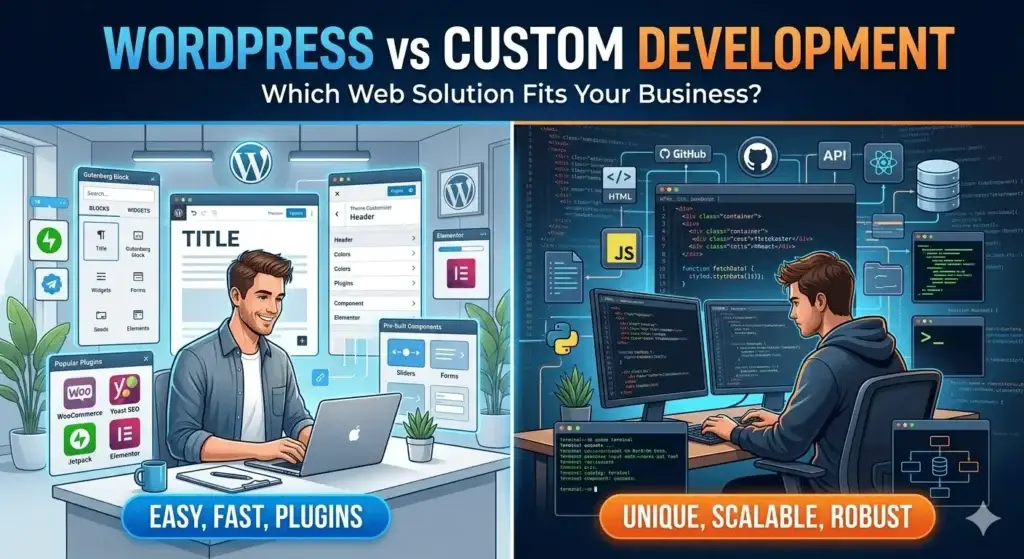
WordPress vs Custom Development: Which Is Right for Your Website in 2026?
You Chose a Platform Without Knowing the Real Cost
You launched your website. Maybe you went with WordPress because it was quick. Maybe you hired a developer for a fully custom build because someone told you it was worth it. Now, months later, one of two things has happened:
Your WordPress site is slow, plagued with plugin conflicts, and you’re paying for three security tools you barely understand. Or your custom site took six months and $30,000 and updating a single paragraph still requires emailing a developer.
Neither outcome is a failure. Both are symptoms of the same root problem: choosing without a clear framework.
In 2026, the WordPress vs custom website debate is more nuanced than ever. AI-powered builders are entering the picture. Performance expectations from Google are tighter. And businesses from Karachi startups to New York enterprises are making this decision with outdated information.
This guide cuts through the noise.
The Real Problem: One Size Has Never Fit All
Here’s the hard truth about the custom website vs CMS debate that most agency blogs won’t say: there is no universally correct answer. What they will say is that their preferred option is right for you because that’s what they sell.
The confusion runs deeper when you look at the numbers. As of April 2026, WordPress powers 42.5% of all websites globally, holding a 59.9% share of the CMS market. That’s a staggering footprint for a single platform. Yet developers on community forums routinely argue that WordPress is a liability for serious businesses and they have a point too.
The problem isn’t WordPress. The problem isn’t custom development either. The problem is a mismatch between what a platform can do and what your business needs it to do.
What the CMS vs Custom Development Debate Actually Costs You
When businesses make the wrong choice, here’s what actually happens:
Choosing WordPress when you shouldn’t: You end up with a site held together by 15 plugins, each introducing a new security surface. Security remains a challenge, with 90% of WordPress vulnerabilities linked to third-party plugins. Performance suffers too, The average loading time for a WordPress website is 13.25 seconds on mobile, a number that Google’s Core Web Vitals will penalize hard.
Choosing custom development when you shouldn’t: You over-engineer a solution for a problem that didn’t need it. A higher initial cost of $15,000–$50,000+ upfront is typical for custom builds, with projects often taking months compared to days or weeks with WordPress.
Both mistakes are expensive. Which means the decision itself is worth getting right.
Agitating the Stakes: What’s Actually Different in 2026
The CMS vs custom development conversation has shifted considerably. Here’s what’s changed and why it matters more now than it did three years ago.
Speed Is a Revenue Line Item
Google’s PageSpeed and Core Web Vitals are no longer optional metrics. They directly impact your search rankings and your conversion rate. WordPress loads extra CSS and JavaScript through every plugin you add, creating what developers call “bloat.” Custom-built sites contain only the necessary code, with well-optimized builds routinely hitting 95–100 scores on Google PageSpeed Insights.
If your revenue depends on search traffic, this isn’t a technical detail. It’s a business decision.
Security Has Become a Board-Level Issue
Popular CMS platforms are frequent targets for hackers and require constant updates, while custom websites are harder to breach due to their unique code structure provided best practices are followed. For businesses in fintech, healthcare, or e-commerce handling sensitive user data, the risk calculus has changed significantly.
The AI Factor
In 2026, SEO isn’t just about Google anymore. AI search engines like Perplexity, ChatGPT, and Gemini are reshaping how content gets discovered. Custom websites give you more control over structured data, which helps search engines and AI systems better understand your content. Technical SEO reforms can also be baked in from the beginning. WordPress can do this with plugins, but the control ceiling is lower.
Developer Sentiment Has Nuance
Real developer communities echo this complexity. Practitioners with 15+ years of WordPress experience note that going with WordPress is justified when you consider it’s tried, tested, completely open source, and very fast to set up but that for businesses requiring professional, unique, and premium experiences where loading speed and SEO are critical, custom development is the stronger investment. The consensus isn’t “WordPress is dying.” It’s “WordPress is right for some things, and custom is right for others.”
The Solution: A Decision Framework That Actually Works
Here is a practical, honest framework for making the WordPress vs custom website decision in 2026.
Choose WordPress (or a CMS) When:
You need to move fast and spend conservatively. WordPress setup is fast and affordable, making it a legitimate choice for startups testing an idea, service businesses needing a digital presence, and bloggers or content-heavy sites. WordPress dominates among freelancers, bloggers, and SMEs because it’s affordable and easy to maintain.
Your team needs to update content independently. The dashboard is genuinely user-friendly. Non-technical staff can publish posts, update pages, and manage media without touching code. If your marketing team needs this autonomy, WordPress delivers it cleanly.
Your features are standard. Contact forms, blog archives, e-commerce with WooCommerce, appointment booking these all exist as mature, battle-tested plugins. Building them from scratch in 2026 is a waste.
Your budget is under $5,000. At this range, custom development simply doesn’t deliver proportional value. A well-configured WordPress site on quality hosting will outperform a cheap custom build every time.
Choose Custom Development When:
Your website is the product. SaaS platforms, web apps, fintech tools, healthcare portals these aren’t websites with a CMS bolted on. They require purpose-built architecture, custom authentication, role-based access, and integrations that no plugin ecosystem can reliably provide.
You’re planning for a serious scale. Custom sites are built with scalable architecture for growth. They can handle increasing traffic and complexity as your business expands. WordPress can scale, but it requires significant ongoing engineering effort to do so cleanly.
Performance is a competitive advantage. If your competitors are running bloated WordPress sites and you need to win on speed, a custom build with React or Next.js can be engineered to load almost instantly. That speed difference compounds over time in both SEO rankings and conversion rates.
You have unique workflows or proprietary integrations. ERP integrations, custom inventory logic, proprietary data pipelines these demand custom code. Forcing complex business logic into a CMS plugin architecture creates fragile, unmaintainable systems.
Your budget supports it. Custom development requires a meaningful investment budget for $15,000+ depending on complexity, plus ongoing developer support. If your business case justifies that investment, the long-term ROI is strong.
The Hybrid Path: Headless CMS
There’s a third option that more businesses are adopting in 2026 and it’s often the right answer for mid-market companies caught between the two extremes.
A headless CMS setup uses a CMS (WordPress, Contentful, or Strapi) purely as a content backend, while the frontend is built with a modern framework like Next.js or React. This approach offers custom design and fast performance alongside easy content updates, supporting future growth and improving SEO with static site generation.
Your marketing team gets the familiar editing interface. Your development team gets clean, performant code they can actually maintain. It’s not cheap to build, but it solves the core tension between editorial control and technical excellence.
Quick Reference: WordPress vs Custom Website in 2026
| Factor | WordPress / CMS | Custom Development |
| Launch Time | Days to weeks | Weeks to months |
| Initial Cost | $500 – $5,000 | $15,000 – $50,000+ |
| Ease of Updates | High (non-technical) | Low (requires developer) |
| Performance Ceiling | Moderate | Excellent |
| Security Control | Moderate (plugin-dependent) | High (custom codebase) |
| Scalability | Good (with effort) | Excellent (built for it) |
| Best For | SMBs, blogs, content sites | SaaS, enterprises, web apps |
The Bottom Line
The WordPress vs custom website question in 2026 isn’t about which technology is better. It’s about which one aligns with your business stage, your team’s capabilities, and your growth trajectory.
Start with WordPress if you’re early-stage, budget-conscious, or building something standard. Invest in custom development when your business has outgrown what templates and plugins can deliver. Consider headless architecture when you need both.
The most expensive mistake isn’t choosing one over the other. It’s choosing without a clear reason and then rebuilding six months later.