
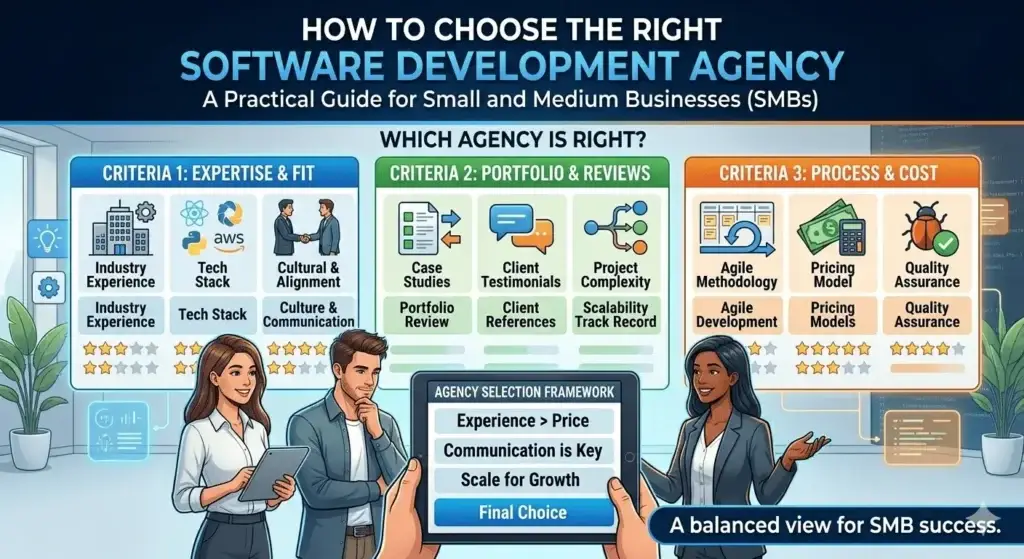
How to Choose the Right Software Development Agency for Your Business
Choosing the right software development agency is one of the most consequential decisions a business can make. The wrong partner can drain your budget, miss deadlines, and deliver a product that misses the mark entirely. The right one becomes a strategic asset accelerating your roadmap, elevating your product quality, and growing with you over time.
Whether you’re a startup building your first MVP or an enterprise modernizing legacy systems, this guide walks you through every factor that matters when evaluating a software development agency.
Define Your Project Needs Before You Start Searching
The biggest mistake businesses make is approaching agencies before they’ve done any internal homework. Before reaching out to a single software development agency, align your team on the following:
- Project scope: Is this a new product, a feature addition, or a full system overhaul?
- Technology requirements: Do you need web development, mobile app development, custom software, API integrations, or AI/ML capabilities?
- Timeline: Is there a hard launch date tied to a business event or funding milestone?
- Budget range: Not a fixed number, but a realistic range that reflects the complexity of what you’re building.
Having these answers documented even roughly transforms your conversations with agencies from exploratory to productive. It also signals to potential partners that you’re a serious, organized client worth working with.
Evaluate Technical Expertise and Tech Stack Alignment
Not every software development agency is built the same way. Some specialize in mobile apps, others in enterprise SaaS, and others in niche industries like fintech or healthcare. Start by assessing whether an agency’s technical capabilities actually match what your project demands.
Key questions to ask:
- What programming languages, frameworks, and platforms does the team specialize in?
- Do they have experience building at the scale your product will eventually reach?
- Are they up to date with modern practices cloud infrastructure, CI/CD pipelines, microservices, security-first development?
Review their public GitHub repositories, case studies, and technology partner certifications if available. A software development agency that can only work in one language or one framework is a red flag if your product requires flexibility.
Review the Agency’s Portfolio and Past Work
A portfolio is evidence. When reviewing a software development agency’s past projects, look beyond the visuals and ask:
- What problems did they solve for previous clients?
- Were those clients in industries similar to yours?
- Do the featured products show genuine complexity like real integrations, user flows, performance considerations?
Don’t hesitate to ask agencies for references you can speak to directly. A five-minute call with a former client is worth more than ten polished case study pages. Ask former clients specifically about communication quality, how the agency handled scope changes, and whether the final product met expectations.
Assess Communication Style and Project Management Practices
Technical skill means nothing without effective communication. Many failed software projects weren’t caused by bad code. They were caused by misaligned expectations, poor status updates, and unclear ownership of decisions.
When evaluating a software development agency, pay close attention to:
- Responsiveness: How quickly do they reply to initial inquiries? Slow responses early on rarely improve once a contract is signed.
- Project management methodology: Do they use Agile, Scrum, Kanban, or a hybrid approach? Do they involve you in sprint reviews?
- Tools and transparency: Will you have real-time visibility into progress through tools like Jira, Linear, Notion, or similar platforms?
- Point of contact: Will you have a dedicated project manager, or will you be coordinating directly with developers?
A good software development agency treats communication as part of the product, not an afterthought.
Understand Engagement Models: Fixed Price vs. Time & Materials
How an agency structures its contracts has a direct impact on your cost, flexibility, and risk exposure. The two most common models are:
Fixed Price: You agree on a defined scope, and the agency delivers it for a set fee. This works well for projects with very clear, stable requirements but can lead to scope creep disputes if your needs evolve.
Time & Materials (T&M): You pay for hours worked. This gives you flexibility to adapt as you learn more about what you’re building. It suits projects where requirements are likely to change which describes most software projects.
Some software development agencies also offer dedicated team models, where you essentially hire a team of developers that works exclusively on your project under your direction. This is increasingly popular for startups that need full-time capacity without the overhead of in-house hiring.
Ask any agency to walk you through exactly how change requests, additional features, and scope expansions are handled under their preferred model. The answer reveals a great deal about how they operate under pressure.
Scrutinize Quality Assurance and Testing Processes
Great software doesn’t just work on launch day it works under load, edge cases, and real user behavior. Ask any software development agency you’re considering how QA is handled:
- Is testing integrated throughout the development cycle, or bolted on at the end?
- Do they conduct automated testing, manual testing, or both?
- How do they handle regression testing when new features are added?
- Who is responsible for testing dedicated QA engineers or the developers themselves?
An agency that treats QA as optional or secondary is a significant risk. The cost of fixing bugs post-launch is always higher in money, reputation, and user trust than preventing them during development.
Consider Location, Time Zone, and Cultural Fit
Offshore and nearshore software development agencies can offer significant cost advantages. But time zone differences and cultural mismatches introduce communication friction that can compound over months.
There’s no universally correct answer on location. Many businesses work successfully with agencies across multiple time zones. What matters is how the agency manages the coordination:
- Do they offer overlapping working hours for real-time collaboration?
- Are there local or regional account managers who can bridge cultural and communication gaps?
- How have they handled time zone challenges with past clients?
Cultural fit also extends beyond geography. Does the agency’s work ethic, feedback culture, and attitude toward ownership align with your team’s? A partner who pushes back thoughtfully on your ideas is often more valuable than one who simply executes.
Evaluate Post-Launch Support and Long-Term Partnership Potential
The relationship with a software development agency shouldn’t end at launch. Software requires ongoing maintenance, performance monitoring, security patches, and iterative improvements. Before signing, clarify:
- What does post-launch support look like, and is it included or billed separately?
- What are the SLAs (Service Level Agreements) for bug fixes and critical issues?
- Can the agency scale up or down team size as your needs change?
The best software development agencies think in terms of long-term partnerships, not one-off projects. If an agency seems primarily interested in closing the deal and less interested in your long-term success, that’s a warning sign.
Red Flags to Watch For
Even well-researched selections can go wrong if you ignore early warning signs. Watch out for:
- Unrealistically low quotes: If a proposal comes in dramatically below competitors, ask why. It often means corners will be cut, or scope will be negotiated away during execution.
- Vague discovery process: Agencies that skip a thorough discovery phase and jump straight to a proposal often miss critical requirements.
- No dedicated team or high turnover: If the agency can’t tell you exactly who will be working on your project, or if staff churn is high, knowledge continuity becomes a serious problem.
- Lack of documentation practices: Code without documentation is a liability. Ask specifically how they document architecture decisions, APIs, and onboarding instructions.
Questions to Ask Every Software Development Agency
Use these in your evaluation calls:
- Can you walk me through a project where something went wrong, and how you handled it?
- Who specifically would work on our project, and what are their backgrounds?
- How do you handle situations where our requirements change mid-project?
- What does your discovery and scoping process look like?
- Can you provide two or three client references from projects similar to ours?
- How do you approach intellectual property ownership and code confidentiality?
- What does your handoff process look like if we decide to bring development in-house later?
The quality of an agency’s answers to these questions is often as revealing as their portfolio.
Making the Final Decision
After you’ve gone through discovery calls, reviewed portfolios, checked references, and compared proposals, the final decision often comes down to confidence. Ask yourself:
- Do I believe this team understands our problem deeply?
- Do I trust them to communicate honestly when things get difficult?
- Do I see evidence that they’ve solved problems like mine before?
The right software development agency will challenge your assumptions, bring domain expertise you don’t have, and deliver a product that reflects their best work, not just the minimum viable version of yours.
Take the time to evaluate thoroughly. The due diligence you invest before signing a contract pays dividends throughout every phase of the development process and long after launch.