
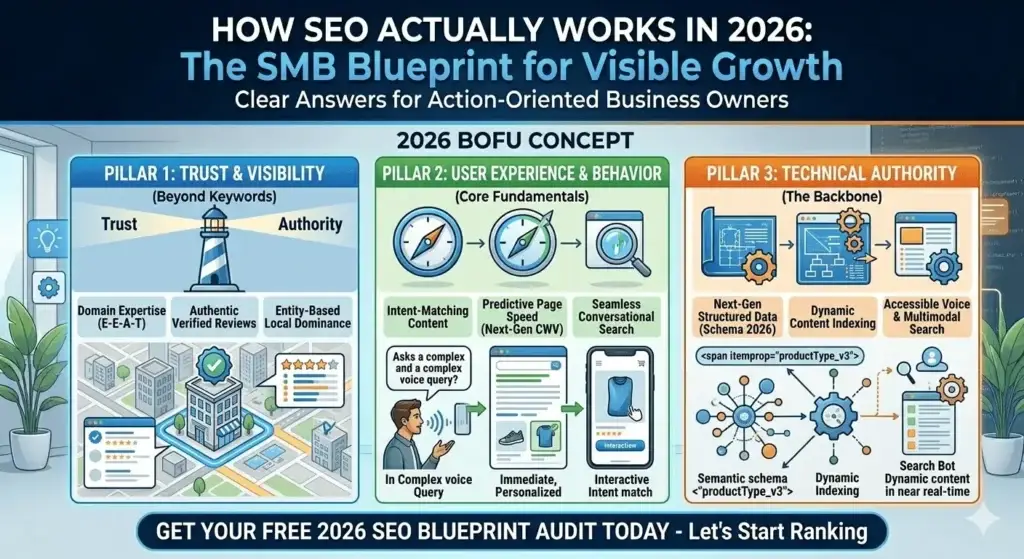
How SEO Actually Works in 2026: A Practical Guide for Business Owners
If you’ve noticed your organic traffic behaving differently. More zero-click visits, lower click-through rates despite solid rankings, or strange new referral sources labeled “AI” in your analytics you’re not imagining it. SEO in 2026 has fundamentally changed, and most of the tactics that worked even two years ago have been quietly replaced by a new set of rules.
This guide breaks down exactly what’s happening, what still works, what doesn’t, and what you need to do right now to stay visible in an AI-driven search landscape.
The Biggest Shift: From “Ranking” to “Being Cited”
For decades, SEO success meant one thing: ranking on page one of Google. You published content, earned backlinks, optimized your metadata, and watched your blue link climb the results page.
That model still exists but it’s no longer the whole story.
In 2026, a significant portion of search queries are now answered directly by AI systems. Google’s AI Overviews appear in at least 16% of all searches. ChatGPT has surpassed 800 million weekly users. Perplexity processes roughly 780 million queries monthly. When users ask these platforms a question, they don’t get ten blue links. They get a synthesized answer generated from multiple sources with citations at the bottom.
The question for your business is no longer just “where do I rank?” It’s “does the AI cite me when it answers questions in my industry?”
This is the core idea behind Generative Engine Optimization (GEO) and understanding it is the most important thing a business owner can do for their digital visibility right now.
What Is GEO, and How Does It Relate to Traditional SEO?
GEO (Generative Engine Optimization) is the practice of structuring your content and digital presence so that AI-powered platforms including ChatGPT, Google AI Overviews, Perplexity, Claude, and Gemini retrieve, cite, and recommend your brand when generating answers.
If traditional SEO was about earning a spot among ten blue links, GEO is about earning a place among the two to seven sources an AI model typically cites in a single response.
The good news: GEO builds directly on SEO fundamentals. If you’ve been doing solid SEO work publishing authoritative content, earning quality backlinks, maintaining a technically healthy website you’re already partway there. The same E-E-A-T signals (Experience, Expertise, Authoritativeness, Trustworthiness) that Google’s algorithm rewards are the same signals AI systems use to decide whose content to trust and cite.
The key difference is this: ranking on page one of Google no longer guarantees you’ll appear in AI answers. Research from GEO analytics firm Brandlight found that the overlap between top Google links and AI-cited sources has dropped from 70% to below 20%. The gap is widening as AI systems develop their own preferences for which sources to include.
How AI and SEO Now Work Together
Understanding the relationship between AI and SEO requires understanding how AI search engines actually process queries.
When someone types a question into ChatGPT or Perplexity, the AI doesn’t simply match keywords. It breaks the question into smaller sub-queries, searches for each one, evaluates the authority and structure of the content it finds, and synthesizes a coherent answer citing the sources it trusts most.
This means AI models reward content that is:
- Directly answerable the first 200 words of your article should answer the primary question, not build slowly toward it
- Factually specific a claim like “email marketing delivers 42x ROI” is far more likely to be cited than “email marketing performs well”
- Clearly structured headers formatted as questions (e.g., “How long does SEO take to show results?”) mirror how users actually query AI systems
- Third-party validated AI models heavily favor content that earns mentions on authoritative external platforms like Reddit, industry forums, Wikipedia, and news publications
One critical technical note that many businesses miss: check your robots.txt file. Cloudflare recently changed its default configuration to block AI bots. If you use Cloudflare, your site may be invisible to AI search systems without you even realizing it.
Google Ranking in 2026: What Still Matters
Despite all the changes, traditional Google ranking signals have been elevated. Google’s December 2025 Core Update hit sites that had been using AI to generate large volumes of generic content purely for ranking manipulation. Human editorial oversight and original insight are now essential, not optional.
Here’s what still drives Google ranking in 2026:
Topical authority over keyword targeting. Google’s systems now evaluate whether a site covers a subject deeply across multiple interconnected pages, not whether individual pages match a keyword. Build content clusters around core topics, not isolated articles.
Backlinks but quality over quantity. Earning a single editorial mention from a respected industry publication outperforms dozens of low-quality links. The strategy has shifted toward original research, expert interviews, and resources that authoritative sites genuinely want to reference.
Technical health. Page speed, mobile responsiveness, Core Web Vitals, and crawlability remain non-negotiable. Google continues to prioritize pages with strong Lighthouse performance scores.
Zero-click reality. A SparkToro study from Q4 2025 found that 56% of desktop Google searches are now zero-click users who find their answer on the results page without visiting any website. This means your SEO strategy can no longer be built purely around click-through traffic. Brand visibility and direct search volume are now valuable outcomes in themselves.
The Practical GEO Strategy for Business Owners
Here’s what to actually do, in order of priority:
1. Audit your AI visibility today. Open ChatGPT, Perplexity, and Google with AI Overviews enabled. Type in the questions your ideal customers ask. Note which brands are being cited. If your competitors appear and you don’t, you have a clear gap to close.
2. Rewrite your content structure. Your best-performing pages should lead with a direct, specific answer. Reformat H2 and H3 headers as questions that mirror actual search queries. Add statistics, data points, and citable claims throughout AI models are drawn to content they can quote accurately.
3. Build your off-site footprint. AI systems scan far beyond your own website. They evaluate your mentions on Reddit, reviews on industry forums, your Google Knowledge Graph profile, and citations in third-party publications. Any brand that hasn’t started building community presence and earning digital PR coverage needs to start now.
4. Implement structured data. Schema markup particularly FAQ, HowTo, and Article schema helps both Google and AI systems understand and extract your content correctly. For e-commerce businesses, making product data like price, stock, and specifications machine-readable through schema is especially critical.
5. Continuously refresh your content. AI systems favor recency. Content that hasn’t been updated in 12–18 months is increasingly deprioritized in AI-generated responses. Build a quarterly review cycle for your top-performing pages.
Measuring Success Has Changed Too
The old dashboard keyword rankings and organic sessions are no longer sufficient on its own.
The new measurement framework for SEO in 2026 includes:
- AI Share of Voice (AI SOV): How often does your brand appear in AI-generated responses for queries in your industry?
- LLM Referral Traffic: Segment traffic in GA4 specifically from AI platforms like ChatGPT and Perplexity to track volume and conversion quality
- Citation vs. Mention ratio: A citation (clickable link in an AI answer) is more valuable than a mere brand mention track both separately
- Branded search growth: When AI mentions your brand, people often search for it directly afterward rising branded search volume is a downstream signal of GEO success
Tools like Ahrefs Brand Radar, Semrush AI Visibility Toolkit, and Otterly.ai now track AI share of voice across multiple platforms. If you’re serious about visibility in 2026, at least one of these belongs in your analytics stack.
What to Stop Doing
Alongside the new priorities, a few old tactics are actively harmful in 2026:
- Publishing AI-generated content at scale without editorial oversight. Google’s December 2025 update specifically targeted this. Thin, generic AI content that exists purely to capture search traffic is being devalued rapidly.
- Optimizing for rankings without considering conversion. Ranking for keywords that attract visitors with no buying intent wastes budget and inflates metrics that don’t correlate with revenue.
- Ignoring platforms beyond Google. Your customers are already using ChatGPT, Perplexity, and voice search to discover businesses. Optimizing only for Google is like optimizing only for desktop in 2015.
The Bottom Line
SEO in 2026 is not dead. It’s broader, more demanding, and more rewarding for businesses that understand the new rules.
Authoritative content, technical excellence, genuine backlinks, a clear understanding of your audience’s intent are the fundamentals . What’s changed is the surface area. You’re no longer optimizing just for one search engine and one type of results page. You’re building a trusted brand presence across an ecosystem of AI platforms, each of which has its own logic for deciding which sources to cite.
The businesses that treat this shift as an opportunity rather than a disruption investing in content depth, off-site authority, and AI-native measurement will build compounding visibility advantages over the next several years.
Start with a simple audit: ask the questions your customers ask, across every major AI platform, and see whose name comes up. Then build the strategy to make sure it’s yours.